The Laboratories….. Researchers working on Myotonic Dystrophy

Here are a few of the labs working on Myotonic Dystrophy

Dr. Puymirat Quebec, Canada
The major aim of the Puymirat lab is to develop a genetic therapy for Steinert dystrophy. During the last few years, the Puymirat lab developed a genetic approach capable of restoring normal functions of the affected human muscle cell. Indeed, Steinert dystrophy is caused by an abnormal accumulation of RNA in the nucleus of muscle cells. The therapy developed by the Puymirat lab is based on the specific destruction of RNA using antisense RNA and ribozymes. The research group showed in vitro that specific destruction of mRNA restored normal functions of the cell. In vivo, intramuscular injection of vectors producing antisense RNA or ribozymes reduced the levels of mutated RNA by 80%. The team is currently studying the effectiveness of this therapy in mice carrying the pathology.

Continue reading

New Novel Drug – Testing in Myotonic Dystrophy – Isis

Recently Isis Pharmaceuticals gave a talk at the myotonic dystrophy foundation conference in San Fransisco, CA. This talk including just information that had been publicly given out previously. However, one of the lead researchers in the Myotonic Dystrophy field commented that this new drug that Isis is pursuing in collaboration with Biogen could be the “Fountain of Youth Drug”. The basic mechanism of antisense technology, if aging is caused by cell clogging with these proteins that are not being released to proper area. This could be a hug huge blockbuster drug that would exceed everyone potential.

Continue reading

Autism Spectrum Disorder in Congential and Childhood Myotonic Dystrophy

Issues and problems with children that have congenital or juvenile myotonic dystrophy are many and hard to pin down. One of the most asked questions is about Autism and do children with Congenital Myotonic Dystrophy have Autism or Autism spectrum disorder. The basic criteria more are defined below for Autism like Features are before 3 years old the following 3 features are delayed or not present:

(A) social interaction,
(B) language as used in social communication
(C) symbolic or imaginative play

The most advanced countries in the world studying these diseases are in the Scandinavian countries. Sweden has taken the lead in publishing a number of English studies that have helped understand this condition.  Dr, Eckstrom and others have done a fine job in the area of pulling more information out of surveys and studies to assist us with the understanding of this disease. This article is going to summarize the results of a study that was finished in 2008. There is a lot of information here so it will be a longer post:

Continue reading

Congenital Myotonic Dystrophy

Congenital Myotonic Dystrophy is present at the birth of the Infant. A mother may notice excessive amniotic fluid or polyhydraminos. The mother may also notice less fetal movements than is normal.  The baby is born sometimes prematurely. It is a disease that will cause multiple symptoms in the baby. The link to the baby is the mother in almost all cases. For instance, out of 118 cases only 2 cases had any incident that the father was the carrier. However, Paternal transmission (by the father) is documented. (Paternal Transmission of Congenital Myotonic Dystrophy J Med Genet 1994;31518-520)  It seems as though the mother somehow causes the disease in the severe form. Some researchers postulate that there does not seem to be a genetic reason for the severe problems that may be caused by the disorder. It may be that the Myotonic Dystrophy in the mother somehow causes the severe congenital form.
In Sweden there is identified two types of congenital myotonic dystrophy, severe and moderate. In the severe type there is a life threatening condition at birth. This seems to be associated with male children more than female. With the moderate type of congenital myotonic dystrophy there is no life threatening condition birth. This information is contained in several studies as well as confirmed by by Ekstrom at a recent conference. The severe type will generally have more symptoms and more severe symptoms of the disease.
Congential as well as juvenile and adolenscent myotonic dystrophy are hard to diagnosis and identify. Part of the reason for this is that the medical profession does not recongnize this disease as a separate and distinct disease. They symtoms of congenital myotonic dystrophy are separate and distinct from mytonic dystrophy type 1. Thus, its hard for parents to identify the disease that their child may have. For example mental retardation and autism spectrum disorder are not symtoms of myotonic dystrophy. But they are symtoms of the congential or juvenile forms of the disease.
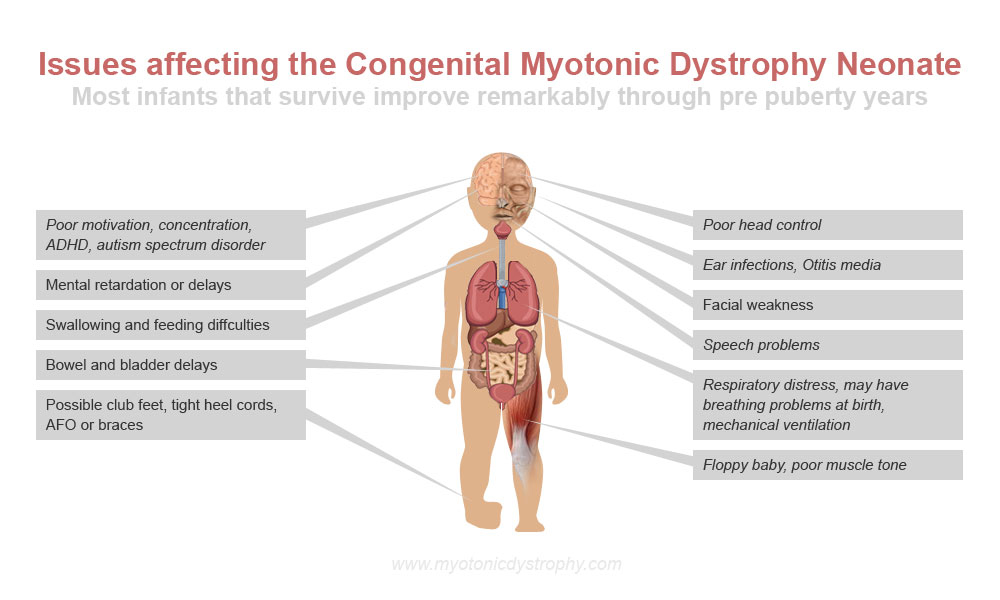
effects of Congenital Myotonic Dystrophy

Continue reading

Heart Review Myotonic Dystrophy

Editors note: This article was written in 2002 approximately 10 years ago. Its a review but more current information must be reviewed as well

MYOTONIC DYSTROPHY AND THE HEART

This article has been cited by other articles in PMC.

Myotonic dystrophy (dystrophia myotonica, DM) is the most frequently inherited neuromuscular disease of adult life. DM is a multisystem disease with major cardiac involvement. Core features of myotonic dystrophy are myotonia, muscle weakness, cataract, and cardiac conduction abnormalities. Classical DM (first described by Steinert and called Steinert’s disease or DM1) has been identified as an autosomal dominant disorder associated with the presence of an abnormal expansion of a CTG trinucleotide repeat on chromosome 19q13.3 (the DM 1 locus). A similar but less common disorder was later described as proximal myotonic myopathy, caused by alterations on a different gene on chromosome 3q21 (the DM2 locus). This article will mainly focus on DM1. It will provide an insight into the epidemiology and genetic alterations of the disease and provide up-to-date information on postmortem and clinical findings and on diagnostic and therapeutic options in patients presenting cardiac involvement.

EPIDEMIOLOGY AND CLASSIFICATION OF DM1

The incidence of DM1 is estimated to be 1 in 8000 births and its worldwide prevalence ranges from 2.1 to 14.3/100 000 inhabitants.1 Based on the age of onset and on its clinical features, DM1 can be divided into three forms: congenital, classical, and minimal, which may occur in the same kindred.

Continue reading