About Richard

Inventor, entrepreneur, father, medical device manager.

Falls and stumbles in Myotonic Dystrophy DM Patients

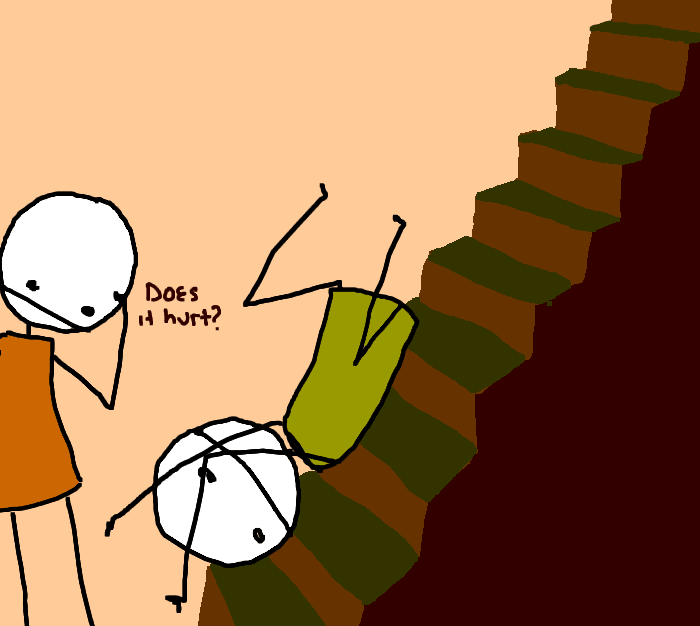
Falls and stumbles are TEN times more likely in patients with myotonic Dystrophy that in a normal healthy population. One reason for the fall or stumble would be for a sustained muscle contraction that can not be counterbalanced by other muscles. Fall prevention programs should be implemented for patients with DM.


J Neurol Neurosurg Psychiatry. 2006 March; 77(3): 393–396.

Published online 2005 September 30. doi:  10.1136/jnnp.2005.066258
PMCID: PMC2077718

Falls and stumbles in myotonic dystrophy

This article has been cited by other articles in PMC.

Abstract

Objective

To investigate falls and risk factors in patients with myotonic dystrophy type 1 (DM1) compared with healthy volunteers.

Methods

13 sequential patients with DM1 from different kindreds were compared with 12 healthy volunteers. All subjects were evaluated using the Rivermead Mobility Index, Performance Oriented Mobility Assessment, and modified Activities Specific Balance Confidence scale. Measures of lower limb muscle strength, gait speed, and 7‐day ambulatory activity monitoring were recorded. Subjects returned a weekly card detailing stumbles and falls.

Results

11 of 13 patients (mean age 46.5 years, seven female) had 127 stumbles and 34 falls over the 13 weeks, compared with 10 of 12 healthy subjects (34.4 years, seven female) who had 26 stumbles and three falls. Patients were less active than healthy subjects but had more falls and stumbles per 5000 right steps taken (mean (SD) events, 0.21 (0.29) v 0.02 (0.02), p = 0.007). Patients who fell (n = 6) had on average a lower Rivermead Mobility score, slower self selected gait speed, and higher depression scores than those who did not.

Conclusions

DM1 patients stumble or fall about 10 times more often than healthy volunteers. Routine inquiry about falls and stumbles is justified. A study of multidisciplinary intervention to reduce the risk of falls seems warranted.

Continue reading

Symptoms that Bother Patients with DM1 the Most

The study looked at  PRISM-1 for “patient-reported impact of symptoms in myotonic dystrophy type 1” — was conducted in two parts. What was surprising is that Fatigue and mobility are the two items that affect Dm1 patients the most.

Phase 1 involved interviews with 20 people age 21 or older with adult-onset MMD1. (People with congenital- or juvenile-onset MMD1 were not included in this study. These diseases have separate symptoms, onsets, and progression paths)

In the interviews, people were asked to identify the symptoms of DM1 that have the greatest effect on their lives. Recurring similar comments were grouped to identify 221 important DM1 symptoms, which the investigators then divided into 14 themes. All 20 people who were invited to participate in this phase did so.

Continue reading

Myotonic Dystrophy found to be cause of 9.7% of unknown Polyhydraminos

Excess amniotic fluid that surrounds the baby is one clue in diagnosis of myotonic dystrophy. This causes preterm labor and potential severe issues in the children. This study looks at cases of unknown polyhydramnois and concluded that 9.7% of this population that was studied had DM

Am J Obstet Gynecol. 1998 Oct;179(4):974-7.

Myotonic dystrophy is a significant cause of idiopathic polyhydramnios.

Source

Department of Obstetrics and Gynecology, University of Utah School of Medicine, Salt Lake City 84132, USA.

Daytime Sleepiness in Myotonic Dystrophy Causes

This is a study (1994)  that looked at the causes of sleepiness in patients with myotonic dystrophy. They concluded that these sleep issues are not caused by sleep apnea. A number of the patients were able to get some relief with Ritalin. Ritalin has a low amount of cardiac side effects. However, this drug may have some cardiac side effects so clear it with your doctor cardiologist before use

Daytime Sleepiness is not caused by Sleep Apnea

J Neurol Neurosurg Psychiatry. 1994 May;57(5):626-8.

Daytime sleep in myotonic dystrophy is not caused by sleep apnoea.

Source

Department of Neurology, University Hospital Rotterdam-Dijkzigt, The Netherlands.

Abstract

Daytime sleepiness is common in myotonic dystrophy and might be attributed to disturbed nocturnal breathing. Seventeen out of 22 patients complained of excessive daytime sleepiness, resembling “idiopathic hypersomnolence”. Sleep apnoea might have contributed to daytime sleepiness in only three of 17 patients. Treatment with the central stimulant methylphenidate produced sustained benefit in seven out of 11 patients tested. Daytime sleepiness in myotonic dystrophy is usually caused by dysfunction of central sleep regulation and not by disturbed nocturnal breathing.

Ritalin and Daytime Sleepiness in Myotonic Dystrophy

Sleepiness is a  issue with some adults and children with Myotonic Dystrophy. Sleepiness or Hypersomnia can have great impact on the social life of patients with myotonic dystrophy. Some patients have reported relief with Provigil although studies have indicated that there is no overall benefit. Provigil may work to help mobilize the sleep patterns so that a person can attend an event but then catch up on sleep later. A new study is looking at a different drug.

This study is by one of the worlds experts in the Disease (DM1) Dr. Puymirat in Quebec, Canada. This article  studies Dr. J PuyrimatRitalin (20mg) and Myotonic dystrophy related to sleepiness with some good results. However, it is noted that palpitations are a side effect of the study. The risks with Ritalin are low but make sure to see a cardiologist before using or having Ritalin prescribed.

Clin Ther. 2012 May;34(5):1103-11.