My most recent blog post on the “Race for the Cure” For Myotonic Dystrophy drugs and a potential cure had stated that the market size that is reachable for this disease is between 2-5 Billion dollars. Today a recent Wall St. Journal Article “The Big Business of Orphan Drugs” confirms that the market for These type of Orphan Drugs is extremely lucrative for companies and patients alike. Read about Small is Lucrative for Drug Companies. The Wall St. Journal article of course is not available without a Subscription.
The Wall street journal reported that incentives from the FDA to develop so called orphan drugs can mean quicker and more certain approval, tax benefits for the developer, and seven years of protection from competition after approval. Orphan drugs are defined as experimental treatments for disease with fewer than 200,000 patients at one time.
Many of the individuals with myotonic dystrophy run into issues with Drooping Eyelids. Here is some information from Eyeptosis.com
Patients present with bilateral ptosis and a flat facial expression. Myotonic dystrophy can be distinguished from oculopharyngeal dystrophy by the associated systemic findings such as “Christmas tree” cataracts, frontal balding, intellectual impairment, and heart block. In addition, the orbicularis weakness and ocular motility deficits are more prominent in myotonic dystrophy compared to OPMD. Diagnosis is confirmed by genetic testing for an expanded CTG repeat in the DMPK gene.
The disorder known as ptosis of the eye can be caused by many contributing factors including, the condition of myotonic dystrophy, an allergy, botulism, a brain tumor, the onset of diabetes, bell’s palsy or other nerve problems that affect the face, Guillain-Barre syndrome, chronic migraine, Multiple Sclerosis (MS), myasthenia gravis, a stroke, a stye, an abscess, an infection caused by bacteria, Cobra venom, eye or orbital tumor, and Horner syndrome. Other causes might also include other sources of nerve damage, aging, and a change in anatomy, recent eye surgery, nerve palsy, or trauma.
Muscular dystrophy is one of the many causes of Ptosis; therefore, both of these conditions are directly related. Myotonic Dystrophy is a continual wasting of the muscles and because Ptosis of the eye refers to weakening of the muscles as a direct result of the nerve endings not properly working, the muscular dystrophy has the ability to cause this drooping eyelid condition. The muscular dystrophy spreads throughout the body, weakening muscles in its path. This condition can commonly affect several of the body’s muscles from working properly, which is primarily what the condition Ptosis is characterized by (weakening of the eye and eyelid muscles, preventing the proper function) Therefore, muscular dystrophy can indirectly cause the droopy eye condition known as Ptosis.
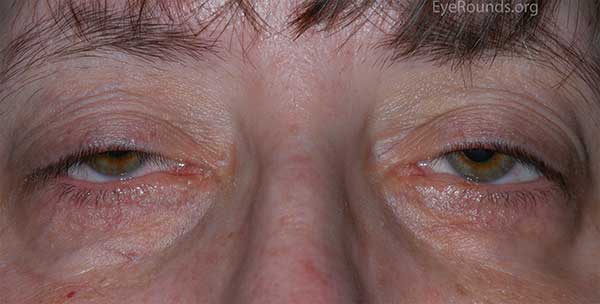
Patient with bilateral ptosis with myotonic dystrophy
The treatment for droopy eyelid depends on the specific cause and the severity of the ptosis.
If the condition is the result of age or something you were born with, your doctor may explain that nothing needs to be done because the condition isn’t usually harmful to your health. However, you may opt for plastic surgery if you want to reduce the drooping.
If your doctor finds that your droopy eyelid is caused by an underlying condition, you will likely be treated for that. This should typically stop the eyelids from sagging.
If your eyelid blocks your vision, you’ll need medical treatment. Your doctor may recommend surgery.
Glasses that can hold the eyelid up, called a ptosis crutch, are another option. This treatment is often most effective when the droopy eyelid is only temporary. Glasses may also be recommended if you aren’t a good candidate for surgery.
Surgery
Your doctor may recommend ptosis surgery. During this procedure, the levator muscle is tightened. This will lift the eyelid up into the desired position. For children who have ptosis, doctors sometimes recommend surgery to prevent the onset of lazy eye (amblyopia).
However, there are risks associated with surgery, including dry eye, a scratched cornea, and a hematoma. A hematoma is a collection of blood. Moreover, it’s not uncommon for surgeons to place the eyelid too high or too low.
Another alternative is a “sling” operation, in which the forehead muscles are used to elevate the eyelids.
Ptosis crutch
The ptosis crutch is a nonsurgical option that involves adding an attachment to the frames of your glasses. This attachment, or crutch, prevents drooping by holding the eyelid in place.
There are two types of ptosis crutches: adjustable and reinforced. Adjustable crutches are attached to one side of the frames, while reinforced crutches are attached to both sides of the frames.
Crutches can be installed on nearly all types of eyeglasses, but they work best on metal frames. If you’re interested in a crutch, consult an ophthalmologist or plastic surgeon who works with people who have ptosis.
Myotonic Dystrophy may be the first of the muscular Dystrophy to have a definitive cure established. In the last few years researchers have isolated the issue they believe causes myotonic dystrophy. In the last couple of years therapies that have targeted this problem have reversed the disease in cell and animal models. This has set up a race now for researchers to refine the therapeutic compounds and begin with human trials to see if the animal to human therapeutic transfer works as it is believed to. Thus, this would lead to the first potential cure for a type of muscular dystrophy.
The Myotonic Dystrophy Foundation (MDF) in Menlo Park, CA has taken a lead in assisting researchers with moving forward with this disease elimination process with funding and assistance in establishing a patient registry. The MDF was the early funder of a new Research Collaborative effort lead by Charles Thorton out of the University of Rochester. The foundation has also been instrumental in educating patients and physicians in this complex and slowly progressing disease that results in premature death. A patient conference is planned for early November of 2013 in Houston, TX
There have been a few questions on the blog about the congenital form of Myotonic Dystrophy and whether this occurs in DM2 patients as well as in DM1 patients. Toba in Canada is the resident expert on DM2 and runs the yahoo groups DM2 but I did find this older article from 2006 on this subject and am posting it here.
Outcome and effect of pregnancy in myotonic dystrophy type 2
10.1212/01.wnl.0000198227.91131.1e Neurology February 28, 2006 vol. 66 no. 4 579-580
S. Rudnik-Schöneborn, MD, et. al Address correspondence and reprint requests to Dr. Sabine Rudnik-Schöneborn, Institut für Humangenetik, RWTH Aachen, Pauwelsstr. 30, 52074 Aachen, Germany; e-mail: srudnik-schoeneborn@ukaachen.de
Abstract
The authors reviewed the obstetric histories of 42 women of 37 families with myotonic dystrophy type 2 (DM2). Nine women (21%) had the first symptoms during pregnancy and worsening in subsequent pregnancies. Of 96 pregnancies, 13% ended as early and 4% as late miscarriages. Preterm labor occurred in 50% of pregnancies resulting in 27% preterm deliveries in women with overt DM2 in pregnancy. There was no evidence of a congenital DM2.
The Muscular Dystrophy Association in Australia is providing information on Congenital Myotonic Dystrophy in English and has recently translated this information into Turkish. Here is a link to both these brochures!