Encopresis

Your Child and Encopresis
Susan Poulton, RNC, ARNP, CNS II and Jeanne Torrens, RN, MSN, CNS II
Updated Spring 2001 by Joni Bosch, PNP

What is encopresis?

When a child who is older than four regularly has stool or bowel movement accidents, the condition is called encopresis. Chronic constipation often leads to encopresis. The stools may be firm, soft, or liquid. We don’t always know why an individual begins to have encopresis.

What causes encopresis?

During toilet training, a child learns how to control bowel movements. During this process, the child is taught to recognize signals from the muscles and nerves that warn it is time for a bowel movement. If something interferes with these signals, then stool accidents will eventually happen.

Encopresis occurs when feces, or stools, are allowed to build up in the colon (or large intestine) over a period of time. This may happen because a child does not have regular bowel movements, or because the bowel doesn’t empty completely on a regular basis. Over time, the feces that stay in the bowel become large, hard, and dry. At this point, having a bowel movement may be painful. Liquid feces often leak out around the hard, dry stool. The colon and rectum stretch. The stretched muscles and nerves give fewer and fewer signals to the child’s brain about the need to have a bowel movement. This decrease in signals results in stool accidents, and the colon and rectum often don’t empty as they should (see Figure 1).

1. Feces or bowel movements move through the colon on their way to the rectum.

2. If these feces aren’t passed…

3. … they will collect into a large mass in the rectum. This can cause a condition known as megacolon. More liquid fecal matter will sometimes run down around the more solid feces.

4. If the child’s sphincter relaxes, liquid waste may leak enough to soil a child’s clothing.

How can I tell if my child has encopresis?

You should be concerned about the possible development of encopresis if you find the following:

Your child has stool accidents or liquid stools at times other than during an illness.

Your child complains about clothing that is too tight around the waist. If you press gently around the edges of your child’s stomach or abdomen, you may find a mass that feels almost like the links of a sausage. The mass might be on one side, or might have the shape of a large, upside down U that runs up one side of the abdomen, across the top and down the other side.

Your child complains of pain related to having a bowel movement. Sometimes a child will tell you that he or she can’t go to the bathroom because it hurts too much.

Your child has a poor appetite. A child with encopresis may complain of a stomach ache, heartburn, or cramps; may feel too full to eat; or may vomit.
Why is encopresis a concern?

Untreated encopresis can lead to several conditions that threaten the health of your child. These conditions include:

Megacolon, a disorder in which the colon gets bigger because of the large amount of feces that stay in the bowel. As the colon gets bigger, its muscles and nerves lose the ability to signal the need for a bowel movement.

Bleeding and cracking of the skin, called fissures, may occur around the rectum as the result of passing large, hard, dry stools. This can be very painful.

Blood may appear in the stool, due to the irritation of the colon lining caused by hard, dry, compacted feces.

Children may develop urinary tract infections and wetting accidents when the overloaded colon presses on the bladder, or prevents the bladder from emptying completely.
Treatment
How is encopresis treated?

The success of any treatment for encopresis will depend on the two factors:

The child’s ability to carry out the treatment plan.
The family’s support of the child.

Encopresis cannot be cured overnight.
It is important to understand what encopresis really is. The problem is not “in the child’s mind.” It is not a “behavior problem.” Encopresis happens because a child’s colon doesn’t work as it should.

The child and the family will need to be patient. It is important that the child isn’t blamed or teased about this condition. Instead, the child should be praised as each step of the treatment is successfully carried out.

The treatment of encopresis begins with the use of enemas to clean out the colon and rectum. When this has been done, the child will need to regularly take laxatives to soften stools and promote bowel movements. The child won’t become addicted to the laxative, or dependent on its use. Laxatives are needed to help clear out the feces. Then the laxative helps the colon begin to work correctly.

In addition, the child will need to use a regular toileting schedule. After each meal and at bedtime, the child must sit on the toilet and try to have a bowel movement. This goal is to establish a pattern of regular bowel movements. It is easier to have a bowel movement after meals because of the gastrocolic reflex that occurs when we eat. As food goes to the stomach to begin to be digested, this reflex makes the intestines contract to move the stool along so that there will be room for more digested food.

As part of toileting, a child will need to practice the Valsalva maneuver. This is the technique of holding your breath while tightening your abdominal muscles and bearing down to have a bowel movement.

Fiber

Fluids

Exercise
Diet and exercise are important.

A child should eat foods that are high in fiber, like fresh vegetables and fruits.
They should drink plenty of fluids throughout the day.
Exercise is also important in starting and maintaining healthy bowel habits.
These three factors — fiber, fluids, and exercise — help keep stools soft and bowel movements regular.

The successful treatment of encopresis typically takes from six to twelve months. It is important to continue both the bathroom schedule and the use of laxatives. This should be done for at least 6 months, while the colon heals.

Remember that even after treatment ends, a child must maintain good eating, exercise, and toileting habits. When this is done, encopresis usually will not recur.

Please note — Before using this information, please discuss it with your family health care provider.

Find more information about this subject in the online catalog of our Disability Resource Library.

“Your Child and Encopresis: Easy Reading Flier”

 

Fatigue

DEALING WITH FATIGUE CAUSED BY MYOTONIC DYSTROPHY

This is based on a lecture delivered at the yearly meeting organized in October 2000, in the Netherlands, by the “Werkgroep Myotone Dystrofie” for patients and other people involved in myotonic dystrophy. Dr. Karlein Schreurs, Health Psychology, University of Utrecht, prepared this lecture. Email to the coordinator of this group: cees.duijndam@wanadoo.nl

Introduction
The work group asked me to prepare a lecture about dealing with fatigue. So I expect that fatigue is a problem for the majority of my audience. The Muscular Disease Association of The Netherlands (VSN) also publishes this. Out of 900 articles on MD (Myotonic Dystrophy) published during the last three years in the international press, eleven were dealing with fatigue. It is obviously a serious problem for many patients but up till now few research-workers pay attention to it. From where is this discrepancy?

Apparently many patients with MD consider fatigue as a symptom that is part of the disease and cannot be cured. I do hope that I can convince you that this is not always true. It is indeed possible to take measures.

A second explanation for this lack of attention for fatigue with MD is the fact that it is difficult to define fatigue.

What is fatigue?

The question seems superfluous. Everybody knows how fatigue feels. However, often we do not mean the same thing. Normally we think of fatigue when a person has worked hard and consequently is physically exhausted. This fatigue is the lack of energy that someone experiences after performing physical exertion. But also people who have been behind their desks for a whole day may complain of tiredness in the evening. At the end of the day they often think it difficult to concentrate and they forget things easier. These too are manifestations of fatigue after mental stress. A person who is bored feels also tired. After a serious flue you may be unpleasantly caught when daily tasks require more effort than usual. Here fatigue is caused by deterioration of one’s physical condition. We can also think of periods when we feel down and sad. We are not in the mood to undertake things because we feel tired. Here fatigue is caused by one’s emotional mood. Finally it appears that fatigue varies from not feeling fit to total exhaustion. In conclusion, we seem to generalize when we speak of fatigue. Fatigue however is a collective noun for an extensive range of varieties.

Countermeasures that fight with success a certain type of fatigue may fail if they are used to fight another type. Here we should make difference between short acute fatigue and long-term chronic fatigue. The differentiation is not only based on the duration of the fatigue. Opposed to short acute fatigue long-term fatigue is often not related to the degree of exertion. A person feels physically tired or finds it difficult to concentrate irrespective of the amount of effort; taking a rest mostly does not cure this type of fatigue. A frequently used questionnaire for fatigue differentiates between physical and mental fatigue and the consequences of fatigue: A slowing down of activities, but also a decrease in willingness to be active (reduced motivation). (Smets e.a. 1995).

Causes
What causes fatigue in people with MD?  This is an unclear area; often more causes can be identified. Muscle-weakness is a symptom of the disease; the disease causing slowness, apathy and lack of initiative may also affect the brains.read more

The physical vicious circle

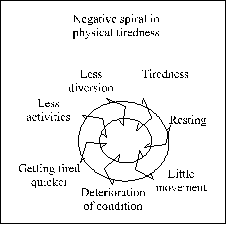
The normal reaction to physical fatigue is rest. Rest does not help when fatigue has a chronic nature. As rest is the accepted remedy for tiredness, most people will rest even more than usual, also influenced by their environment. They hardly have any physical activity. This inactivity deteriorates their physical condition. In this situation any form of activity tires more quickly. The result leads to diminished activity and means therefore less diversion; this now causes the patient to feel more tired. This circle may be broken up by an adapted daily routine. Attention: This routine does not mean to stop completely taking a rest. We are talking of alternation of activities and rest, adapted to the physical abilities. The muscle weakness and loss of power with MD may complicate it even more. Some muscles are weak and it was found that muscle-reinforcing exercises almost not effect the affected muscles (Lindeman, Spaans, Reulen, Leffers, Drukker, 1999). But it came out that exercises do not harm. It is important to exercise the not-affected muscles to optimise their condition without entertaining unreal expectations.

The psychological vicious circle

The second vicious circle relates to psychological factors, which either maintain or intensify fatigue.  If someone feels tired very often he or she may find out that resting hardly helps and therefore it seems that fatigue can hardly be managed.  This leads to low spirits and helplessness.  This depression makes people less inclined to be active and this will result in less activity and less diversion causing a person to feel totally overpowered by fatigue.  In this case looking for control over the situation can break a circle.

It is well known that controlling their situation helps people to feel well.  Often people feel less depressed and it helps to organise the day-to-day routine.  As soon as people pursue a more active lifestyle, social contacts and activities will increase resulting in reduced focus on fatigue.

Remedies
You may wonder how to control the situation.  There are no instant solutions but there are a few approaches.  A first way to get some control is to identify the effects of fatigue, is there a medical solution? read more

Conceptions
Research among people with a chronic fatigue syndrome shows that fatigue is intensified and maintained by high standards and strong principles. Demanding people who are perfectionists run the risk of trying to pursue the impossible, which will exhaust them. This regards principles like: “Everything I do should be perfect, or “Whatever I start I’ll finish it” or “I never reject my duty”. Such principles may seem commendable, but if your energy is limited there will be nothing left after fulfilling the duty. There is nothing wrong when splitting up a job in several pieces. We are often not aware that our behaviour is controlled by this attitude. If you feel unhappy and you find out that you are feeling chased, it is worth while to try to find the cause of those feelings. You may ask yourself questions on the consequences of your conceptions and on your willingness to pay the price for such behaviour

Social aspects

Your partner is also facing the consequences of your disease. The partner wishes to support but is also troubled by fear, concern and helplessness.

When you leave your house by yourself for the first time after a long period of time, your partner may get very anxious about it. Also your partner may think to help you by doing every little job for you. This will make you less active than actually necessary. Discuss such matters with your partner.Finally it is well known that people with a chronic disease tend to withdraw from social life. Fatigue reinforces this tendency. This will deprive you of possible diversion, which again does not help to overcome fatigue and other symptoms. You will also miss possible support, which other people might give you. It is true that people may sometimes react improperly to your fatigue. If you show that you are tired often people will say: “All of us get tired from time to time.” Then the choice is yours: You withdraw from social life because nobody seems to understand you or you explain people that your form of fatigue is different from the usual short fatigue.

With this choice we come back to the beginning of my thesis: “Fatigue may be a symptom of Myotonic Dystrophy but this does not mean that nothing can be done”.Everybody can manage fatigue and its consequences better than you might think, hut this does not occur automatically.

FATIGUE DIARY

Date
Period M A E M A E M E A M E A M E A M E A M E A
3 exhausted
2 tired
1 unfit
Medication
Activities
Date
Period M A E M A E M E A M E A M E A M E A M E A
3 exhausted
2 tired
1 unfit
Medication
Activities
Date
Period M A E M A E M E A M E A M E A M E A M E A
3 exhausted
2 tired
1 unfit
Medication
Activities
Date
Period M A E M A E M E A M E A M E A M E A M E A
3 exhausted
2 tired
1 unfit
Medication
Activities

Feeding Problems

FEEDING PROBLEMS

Many people have contacted us and have expressed concern and interest in feeding issues for people with CMD or Myotonic Dystrophy. Some case studies might give some insight into these issues. Your clinic may not have this updated information, but it’s important to take these issues seriously and discuss them with your doctor!

What is clear is that feeding is a very difficult issue for many people with myotonic and congenital myotonic dystrophy. The regular rules and concepts that people think about can not be applied here. Kids and adults have muscle problems associated with chewing and swallowing. Apparently with certain individuals there are very intense problems with the digestive system, as well. Most doctors will never see a case of myotonic dystrophy and even many experts rarely see a case of congenital myotonic dystrophy. So the resource base on which parents can draw from is virtually nil.

The problems with congenital myotonic dystrophy are compounded by the onset of the adult form, for most patients this occurs in the early teen years. Thus, there is a combination of both the congenital and the early onset of the adult form that might be the cause of these problems.

Thus, the parent is alone to deal with a very difficult situation that they do not understand. Here are a few cases that might shed some light on these difficulties.

Genetic Information

GENETIC INFORMATION


There are  two types of Myotonic Dystrophy
 
DM1 is known as Type 1
DM2 is known as Type 2, and also known as PROMM or “Proximal Myotonic Myopathy
 
DM1 is caused by an expanded repeat of CTG on Chromosome 19
DM2 is caused by an expanded quadruplet repeat of CTG on Chromosome 3
 
Differences in DM1 and DM2
 
DM2 does not seem to cause the severe congenital form when the mother that has the disease has an infant. Also the apathetic personality traits with DM1 do not seem to be associated with DM2. People with DM2 will have more weakness in the trunk of the body (proximal) versus DM1 will have more weakness in the distal parts of the body like legs and arms. The incidence of DM2 is unknown. There is a genetic test for DM2 just available from Athena Diagnostics. Estimation is that the incidence is less than 2% (QUEST Feb 2002) but it may be much higher.


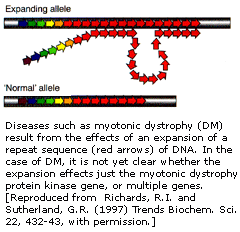
A deficient gene causes DM1.  This is an alteration in the myotonin protein kinase gene, specifically in the APOC2 locus located on the proximal long arm of chromosome 19.  DM is an autosomal dominant condition; this means that only one copy of the gene with a genetic alteration is necessary for DM to occur. The genetic alteration found in the myotonin protein kinase is a repeating sequence of three specific nucleotides (these are the ‘building blocks’ which make up DNA). Normally in gene 19 the sequence of cytosine-thymidine-guanine (CTG) repeats itself from 5-37 times in a row, however in an altered DM gene this CTG sequence repeats 50+ times and in some cases it can exceed 2000.  The number of repeats effects when the age of onset occurs and the severity of DM.  The table below shows how the CTG repeat length/numbers effects the clinical symptoms
Table 1: Correlation of CTG repeat numbers with clinical symptoms
CTG repeat lengths

DM disease Class

Clinical Symptoms

50-100 Symptomatic

Minimally affected Cataracts, mild muscle symptoms
100-1000 Classical adult onset Progressive muscle weakness
Wastage and stiffness
Heart problems
Digestive problems
Diabetes
Increased sleeping (hypersomnia)
Mental impairment
premature balding
Reduced fertility
Breathing problems
Testicular wastage
1000 – 4000 Congenitally affected Breathing difficulties
Initial hypotonia
Feeding Difficulties
Progression in skills possible
until age 5
delays in Milestones
Speech Problems
Delays in Toilet Training
Mental Retardation
 

The numbers of CTG repeats are stable from generation to generation when they are in the normal 5-30 repeats.  The number of CTG repeats may change in number from generation to generation when they are in the range of 50+.  The number of repeats will rarely decrease in number from parent to child.

Figure 1 shows the difference between the normal and the altered CTG repeats

Some authorities maintain that the correlation between the number of repeats and the severity of the illness is not absolute. A key factor they maintain is the age when the first symptoms appear. The earlier the symptoms appear the more likely that the disease may have a more severe manifestation.

The affected mother has a 50% chance of transmitting the mutation to each child. The underlying Myotonic Dystrophy that the mother has is inherited as a “autosomal dominant trait” However, there is some thought that the mother has a “maternal factor” that passes through the placenta and thus is the cause of fetal muscle maturation arrest. (Farkas-Bargeton). There have a a very few documented cases of paternal (father’s) transmission of the congenital form. Click here for more info.

Congenital Myotonic Dystrophy is related and linked very strongly to Myotonic Dystrophy. In virtually all cases the mother must be affected and have Myotonic Dystrophy. Myotonic Dystrophy is a genetic disease that is more progressive between generations. This is called anticipation;  that means that each son or daughter that is affected  may have the disease slightly worse. The CMD condition is potentially the worst outcome of this disease.

Myotonic Dystrophy has the anticipation or amplification factor. Each succeeding generation may have the disease slightly worse. The number of repeats of the CTG sequence gets longer. The onset of Myotonic Dystrophy gets earlier as a general rule as the number of repeats increases. In this family of disorders the number of repeats tend to increase with succeeding generations. Again, this is known as “genetic anticipation”

There also has been a report from England that there can be regression (shrinkage) as the MD allele is passed on to successive generations; this is mostly seen with paternal (through the father which is rare)  transmission. The is also some reports of regression to a repeat number within the normal range

Myotonic and CMD belong to a growing family of disorders where the genetic mutation involves unstable Trinucleotide repeats (C_G) These letters correspond to amino acids which form the basis of DNA. More information on Triplet Repeat Disorders or Triplet Repeat Information. A few related disorders:

Fragile X Syndrome CGG
Myotonic Dystrophy CTG
Huntington Disease CAG
Kennedy’s Disease CAG
Spinocerebellar Atrophy-I CAG
Machado-Joseph Disease CAG

CTG Repeat Numbers

5 repeat and 16-30 repeat alleles have been shown to share the same linkage disequalibrium as DM. It is proposed that the 5 repeat allele expands to alleles in the 16-30 repeat range which then form a pool for recurrent DM mutations. In the absence of a high new mutation rate, this theory explains why myotonic dystrophy is maintained in the population and not lost via the congenital form.

 
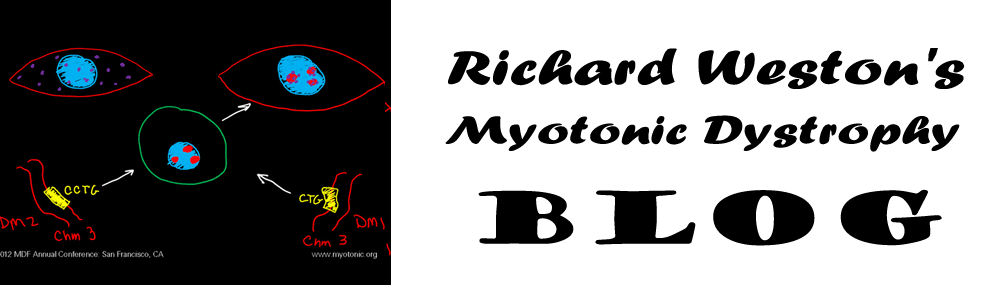
Diagram of How the disease may affect transcription


 Click below for a great booklet on Whether to test for Myotonic Dystrophy

myotonic dystrophy an informed choice of testing

How do I know if I have Myotonic dystrophy

How do I know if I or someone I know has Myotonic Dystrophy?

First you can scan the pages and see if your symptoms match those of people with Myotonic Dystrophy. Some of the symptoms are: A quick visual test is the grip test: Look at these pictures and then try to open and close your hand very rapidly. This are large visual files so may take a minute to open! Use your back button on the browser when done.

Polyhydraminos (Excess amniotic fluid during pregnancy)
Constipation
Cataracts
Ulcerative Colitis (abdominal pains)
Muscle Pains
Hair Loss
Depression
Apathy/Lack of Motivation
Difficulty in swallowing and chewing
Abnormal ECG
Weakness in muscles, Hand, Ankle, Shoulder
Inability to rapidly open and close hand
Hypersomnia (Excessive sleeping)

1


Grip Test   
                 Characteristic Release

DNA Testing

If this still indicates that you may have myotonic Dystrophy you can visit your local Muscular Dystrophy Association if you live in the Untied States. They will arrange for a DNA blood test. The testing measures the number of CTG repeats on Chromosome 19 for DM1 and the number of Repeats on Chromosome 3 for DM2.  There is a foundation that may help with funding for testing. Contact us for more information.

There is also private companies that will do testing. You can send a blood sample to these testing labs and they will analyze the blood for you and send a report. Athena Diagnostics performs testing on both Type 1 and Type 2 Myotonic Dystrophy, DM1 and DM2. The fees for testing are between US$250 and US$350 per test.

Athena Diagnostics
Four Biotech Park
377 Plantation Street
Wochester, MA 01605
508/756-2886 Phone
508-753-5601 FAX
www.athenadisgnostics.com

Baylor College of Medicine
Medical Genetics Laboratories
One Baylor Plaza
Houston, TX 77030
713-798-3863

The normal number of repeats will be up to 5-38. Over this amount indicates that the disease may be present. The number of repeats can be in the thousands for the congenital form. You need to discuss this information with your doctor, the best would be with a neurologist at the Muscular dystrophy clinic in the USA or a Neurologist.

If the test show that an individuals has Dm then  make sure that all affected individuals carries an alert card. Emergency Medical personnel need to know if the person has DM. Click here to get an alert card. You can write our office for a plastic card to be carried in the wallet or purse.

What to bring to the Medical Office for 1st appointment

For your first appointment you might want to bring a medical history of any family members that might be affected. It will also help to print out the guidelines and Care recommendations from the Scottish Medical Society. Click here to access the Medical Guidelines and Care Recommendations.