Long Term Outlook Longevity

LONG TERM OUTLOOK LONGEVITY FOR PATIENTS

Myotonic Dystrophy is a slowly progressive neuromuscular Disease and the symptoms of the disease do gradually get worse over time. However, there are a number of ways to manage the symptoms of the disease and more and more management techniques are becoming available. In the very long-term outlook most people with DM will have shorter life expectancies, One study available at the end of this post gives an average of 59 years for females with DM1 and 60 Years for males

For children with the Congenital form once  beyond the early problems of respiratory distress the prognosis for life is relatively good. There will be improvement in early childhood and children will make steady progress in these early years. Motor function will improve, most children will walk and the marked hypotonia or floppiness will improve or disappear. For most children their performance will be limited by mental capacity and not by physical handicap.

Reardon reports on the outcomes of 115 patients with confirmed diagnosis’s of CMD.   The data suggests a 25% of death before 18 months of age and a 50% chance of survival into the mid-30’s. tables that follow are from Reardon. The Natural History of Congenital myotonic Dystrophy: Mortality and long term aspects. Archives of Disease in Childhood 1993; 68:177-181

               Long-term Survival Probability

Age X

Probability of Survival to Age X

Age X

Probability of Survival to Age X

0

1.000

Days

1

.922

2

.887

3

.878

7

.861

10

.861

12

.843

20

.835

21

.826

Months

1

.807

234 .671

2

.791

240 .657

3

.791

249 .643

4

0774

274 .625

7

.765

304 .598

12

.765

315 .564

14

.757

388 .508

16

.745

462 .339

88

.737

474 .169

186

.724

486 (40 yr.) 0

195

.711

222

.698

223

.685

There was no instance of a congenitally affected patient having children. 48 patients reached the age of 20, 12 reached the age of 30. (of 115 patients). However, Reardon noted that “The degree of precision of estimated survival probabilities at the far end of the life table is recognized to be extremely poor” (or to put is more clearly he’s not sure how good the estimates are in the older years 30-40’s)During the study only 3 such individuals were studied and all died in this age band.

Details of Current Employment among the 48 patients reaching 20 years of Age

Employment No of Patients
Local Government Clerical Worker 1
Cinema Attendant 1
Garden Center Operative 1
Adult Training Workshop 5
Housewife 2
Unemployed 38

Most of the patients with CMD will be unemployed.

Chronic Medical Problems in surveying Patients n=71

Problem Number of Patients Percentage
Constipation/Diarrhea 24 34%
Recurrent Otitis 15 21%
Scoliosis 7 10%
Cardiac Rhythm Disturbance 3 4%
Vesicoureteric Reflux 1 1%

Causes of Death n=44

Cause No of Deaths
Constipation/Diarrhea 34%
Recurrent Otitis 21%
Scoliosis 10%
Cardiac Rhythm Disturbance 4%
Vesicoureteric Reflux 1%

However, during late childhood and early adolescence the “adult” features of myotonic dystrophy appear. Eye problems can be early on detected by the second decade and progressively muscles will be detected gradually weakening. No case of CMD has been found not to develop the adult version. O’Brien reports that of 46 patients with CMD 4 died outside the neonatal period at 4, 18, 19 and 22 years. Four more were considered seriously disabled with a poor prognosis. Problems seen in this group of 30 were gastrointestinal Problems in 8 (Constipation and abdominal pain) Talipes in 5. None in the group had any children and males showed marked testicular tubular failure indicating significant reproductive problems. Thus, long-term prognosis from a medical viewpoint is not bright.

Reardon noted that because of gastrointestinal problems children with CMD will show a positive anal dilation test. This test is sometimes used to diagnosis sexual abuse. Parents with CMD should be aware of this information. This test should not be used for any conclusive evidence of sexual abuse with children with CMD.

However, children with CMD are generally happy and cheerful individuals with a distinct personality and add a lot to family life as a whole. Medical outlook should be integrated with other family factors (see personal stories)

New Study May 1999:

A 10-year study of mortality in a cohort of patients with myotonic dystrophy.

Mathieu J; Allard P; Potvin L; Pr´evost C; B´egin P

Neuromuscular Clinic, Complexe Hospitalier de la Sagamie, Quebec University in Chicoutimi, Canada.

Neurology, 52(8):1658-62 1999 May 12

Abstract

OBJECTIVE: To determine the age and causes of death as well as the predictors of survival in patients with myotonic dystrophy (DM). METHODS: In a longitudinal study, a cohort of 367 patients with definite DM was followed for 10 years. RESULTS: During the 10-year period, 75 of the 367 DM patients (20%) died. The mean age at death (53.2 years, range 24 to 81) was similar for men and women. Among these 75 patients, 32 (43%) died of a respiratory problem, 15 (20%) of cardiovascular disease, 8 (11%) of a neoplasia, and 8 (11%) died suddenly. The ratio of observed to expected deaths was significantly increased to 56.6 (95% confidence interval [CI] 38.7 to 78.0) for respiratory diseases, 4.9 (95% CI 2.7 to 7.7) for cardiovascular diseases, and 2.5 (95% CI 1.1 to 4.6) for neoplasms. The mean age at death was 44.7 years for the childhood phenotype of DM, 47.8 years for the early-adult, 55.4 years for the adult, and 63.5 years for the mild phenotype (F = 4.8, p = 0.005). The age-adjusted risk of dying was 3.9 (95% CI 1.3 to 11.0) times greater for a patient with a distal weakness and 5.6 (95% CI 2.2 to 14.4) times greater for a patient with proximal weakness as compared with a person without limb weakness. CONCLUSIONS: Life expectancy is greatly reduced in DM patients, particularly in those with early onset of the disease and proximal muscular involvement. The high mortality reflects an increase in death rates from respiratory diseases, cardiovascular diseases, neoplasms, and sudden deaths presumably from cardiac arrhythmias.

Full text of Article above

Here is another study abstract on Longevity:

Age and causes of death in adult-onset myotonic dystrophy.

Author

de Die-Smulders CE; H¨oweler CJ; Thijs C; Mirandolle JF; Anten HB; Smeets HJ; Chandler KE; Geraedts JP

Address

Department of Clinical Genetics, Academic Hospital Maastricht, The Netherlands. christine.dedie@gen.unimaas.nl

Source

Brain, 121 ( Pt 8)():1557-63 1998 Aug

Abstract

Myotonic dystrophy is a relatively common type of muscular dystrophy, associated with a variety of systemic complications. Long term follow-up is difficult because of the slow progression. The objective of this study was to determine survival, age at death and causes of death in patients with the adult-onset type of myotonic dystrophy. A register of myotonic dystrophy patients was set up in Southern Limburg (the Netherlands), using data longitudinally collected over a 47-year period (1950-97). Survival for 180 patients (from the register) with adult-onset type myotonic dystrophy was established by the Kaplan-Meier method. The median survival was 60 years for males and 59 years for females. Survival of the patients was also estimated from the age of 15 years to the ages of 25, 45 and 65 years and compared with the expected survival of age- and sex-matched birth cohorts from the normal Dutch population. The observed survival to the ages of 25, 45 and 65 years was 99%, 88% and 18% compared with an expected survival of 99%, 95% and 78%, respectively. Thus, survival to the age of 65 in patients with adult-onset myotonic dystrophy is markedly reduced. A weak positive correlation between the CTG repeat length and younger age at death was found in the 13 patients studied (r = 0.50, P = 0.08). The cause of death could be determined in 70 of the 83 deceased patients. Pneumonia and cardiac arrhythmias were the most frequent primary causes of death, each occurring in approximately 30%, which was far more than expected for the general Dutch population. In addition, we assessed mobility in the years before death in a subgroup of 18 patients, as a reflection of the long-term physical handicap in myotonic dystrophy patients. Half of the patients studied were either partially or totally wheelchair-bound shortly before their death.

More information is available on the lifespan on the congenital form of myotonic dystrophy from a study in 1993. Medical care has improved since then.
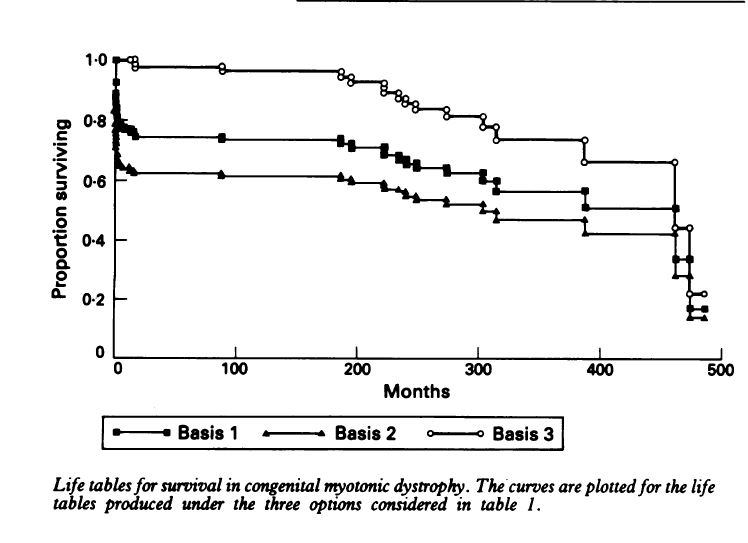

Chart for Life span Congential Myotonic dystrophy
Mortality-and-long-term-clinical-outlook-congential-myotonic-dystrophy

Pneumonia Lung Problems

LUNG PROBLEMS

Lung problems mostly occur during the advanced stage of the disease. Here too the weakness of the breathing muscles is not the main problem, because with MD in the worst case the breathing muscles are slightly affected. Chronic mechanical respiration, which is sometimes necessary with other muscular diseases, is seldom necessary with MD-patients.

The main problem with MD is the acute pneumonia. It is often caused by choking, though the patient is not always aware of it. Obviously he is choking on saliva when asleep, because swallowing is more difficult when lying down than being upright. Pneumonia mostly starts in the lower lobe of the lungs, but it can extend within a few days and become a serious and dangerous infection of a complete lung. This should be treated quickly with antibiotics and cough-medicine. Often admittance to hospital is necessary and sometimes patients require temporarily a mechanical ventilator at an Intensive Care. Sometimes the trachea must be sucked out with a bronchoscope, a flexible thin pipe, slid through the trachea by a lung-physician. Often this way of fighting pneumonia is successful. With some patients who frequently choke, within a few years several times pneumonia occurs. This can be prevented by sleeping at night in upright position, thus preventing choking.. In this case it is wise not to eat in the evening because from a filled stomach sometimes  food is belched up, which can reach the lungs

Management of Myotonic dystrophy

This information is from the 11th annual conference of the English Myotonic Dystrophy

“Myotonic Dystrophy Incurable but not Unmanageable”

The incidence of Myotonic Dystrophy is 1 in 8000. Most general practioners have about 2000 patients in their practice. So by simple mathematics only one in four general practioners will see a patient with DM. Most will not know much about it. So it is necessary to have specialized centers for treatment. (Webmaster note: By implication the congenital form is about 1 in 100,000 so that only 1 in 50 pediatricians will have a patient with CMyD in their practice)

Most other muscular dystrophies will only affect the muscles. DM is different in that other systems are affected as well. Another difference is that with most other genetic diseases you either have the gene and the disease or you don’t. DM is a variable genetic disease. It severity differs with the age of onset and the number of repeats. There is not a distinct expression of the disease based on an on or off view. Thus, many medical practioners will have a harder time understanding the disease. The other implication is that you can not generalize the condition of one patient with the disease to another, it is variable

Skeletal Muscle: The skeletal muscle is defined by Myotonia of muscular stiffness, in particular hand stiffness. Also certain other muscles are weak especially facial, scapula and humorous muscles are mostly affected. However, this stiffness is generally not he problems that patients report more, it is the weakness of the hand and other muscles that comes into play. This is more the day to day problems that weaker muscles may cause. Weakness of the grip seems to be the most problematic. A normal male should be able to squeeze about an equivalent of 50Kg. A patient with DM may only be able to squeeze the equivalent of 10-1Kg for example. Also weakness of the ankle muscles causes the characteristic gait of DM. Dr. Jones mentioned that a patient of his was unable to blow into a breathalyzer machine So Dr. Jones felt it was more the practical issues of weakness more than the myotonia that affect DM patients

Smooth Muscles: One of the primary effects of DM on smooth muscle is that swallowing and feeding are much more difficult. What is generally recommended is that food should be cut into small pieces and drink used to wash this down. Care must be taken to avoid aspiration pneumonia, that is food going down into the lungs and causing pneumonia. Dr, Jones mentioned a drug Cysotia?? (Margaret can we get clarification here) or surgery that might be needed to assist. Also a video Fluoroscopy will help diagnosis any feeding problems.

The smooth muscles also affects the bowel and notably irritable bowel syndrome is very common in patients with DM. This is failure of coordination of muscles. Constipation is also a complication because of muscle problems plus immobility of patients not moving. Surgery is not recommend and Dr. Jones has heard reports of patient deaths with surgery. The Uterus is also affected and problems in childbirth may result.

The heart is affected in other dystrophies but in DM it is not the heart muscle itself that is affected. Rather, it is problems with the electrical signals not working properly and the heart either working to fast or too slowly. Atrial fibrillation is when part of the heart is not working efficiently, pumping to fast and not coordinated) and this can cause dizzy spells and blackouts, can be treated. The heart can also pump too slow causing the same symptoms. Heart changes are slow to respond to changes in the body. Dr. Jones recommended an EKG every year to look for problems.

Eyes and Ears: Cataracts can be the first evidence of myotonic dystrophy disease. Generally, if cataracts are seen in patients under 50 DM should be considered. There is nothing special about the mature form of cataracts. However, in the early stages there is a characteristic pattern that can be seen that is unique to DM. A mild degree of deafness is due to DM but not serious.

Brain. On average IQ is a little lower. In the congenital form IQ is reduced and most children will have learning disabilities. The mental problems are pretty static with little change over time.

Excessive Daytime Sleeping: 75% of DM patients have excessive sleepiness. In a survey they conducted 120 responses were received and 40% of patients had a pathological sleeping problem. There is a new drug Modafinil (Brand name Provigil in USA) that might help. Make sure to take it in the morning!

Breathing: The lungs are affected as well as the heart. The anesthesiologist should be informed as well as the surgeon prior to any surgery. Certain precautions must be taken. DM suffers should wear a bracelet as well as cards in case of an accident. The group had a handout on anesthesia that was in some of there earlier newsletters.

Endocrine System: There is reduced fertility in patients with DM. There is also diabetes. Dr. Jones didn’t feel that DM diabetes falls into the classical sense of Diabetes. Feels that all patients with DM have problems with sugar levels. (My note: Might possibly have a different Mechanism of action?). Would be nice to get some more information on this.

Dr. Jones feels that the age of onset is a more potent predictor of outcome versus the number of repeats. There is the anticipation factor where in each generation the outcome becomes progressively worse.

Genetic counseling: Family needs to be screened especially women to prevent them from unknowingly having an infant with CMyD. When an individual is identified strong efforts should be considered to have other family members tested to avoid them having CMyD. For example Dr. Jones considered an example of a 28 year old male who was confirmed diagnosis with DM. He had 2 sisters one 25 and one 21. The 21 year old sister went on to have a child with CMyD because she was not informed or tested.

Link to Article by Dr. Carter on Management of Neuromuscular Diseases

Trip to the MDA Clinic

Each kid in the USA gets to go to the MDA clinic a couple times per year. These clinics are great and allow you to meet with Dr’s and Nurses. The MDA pays for the visit if you do not have insurance. They also help with payment for stroller, wheelchair, etc. if you do not have the money to pay for this.

MDA Clinic at California Pacific Medical Center in San Francisco, CA USA (415)921-2101

At the Clinic you will meet with:

  • Nurse who takes Blood Pressure weight etc.
  • Doctor who checks on physical well being
  • Social Worker
  • Physical Therapist
  • Occupational Therapist
  • Speech Therapist
  • MDA Representative
We usually go to clinic once or twice per year. It helps to give some perspective. and to see what is going on with the MDA and get the knowledge of these workers.

We usually go to clinic once or twice per year. It helps to give some perspective. and to see what is going on with the MDA and get the knowledge of these workers.

Chris does not like to go to Doctors and Hospitals etc. So he usually is a little upset at first. But then he calms down. We usually bring his radio or tape recorder and this calms him down a bit.

Here is Chris and Dad at the Clinic. Chris really likes his radio and we have tape and book sets that he really likes.

Chris can entertain himself with the his radio and books quite well.

Here is Chris with Aunt Lori in the waiting Room. My sister helps me a lot with Chris. Thanks Lori!

Here is Dr. Mednick at the Clinic. He is great and spent a lot of time with us. He has been with MDA for a very long time and knows his stuff. Very good with patients. He’s only there two days a month so make sure you go when he is available. Dr. Mednick phone is (415) 921-2101 FAX (415) 457-0602

Here is one of the great therapists. She was very helpful. See the pink tube. This is a nice toy that Chris really liked. It helped focus his attention

So that’s the good. What you should not expect is that the Clinic will give you a lot of new information. If you’ve read this page you probably know more than the staff about this condition. Be proactive. We got a 12 lead ECK done with Chris when we were there last. It helps to have all the tests as a base line so the Doc’s can know what to expect. Some people have reported not good experiences at their clinics. We have been to three different clinics. One in Rockford, IL USA, One in Chicago, IL USA and this clinic in California. Each one does things a little different. The California clinic was different in that that had a knowledge doctor who spends time with you. The head of the Clinic Dr. Miller is great but really busy. He spent about 3 minutes with us versus the 50 minutes with Dr. M. So you can tell this clinic is sharp as they take care of patient needs in a very effective manner. You’ll find each clinic a little different… We’ve found that clinics in rural area’s are not as knowledgeable. They probably see less patients and therefore do not know as much. Help to educate them and give them this web site. Don’t expect them to read it though. Dr’s are very busy and have little time for education when real patients call. If you find one with knowledge make sure to stick with them and let me know. I will post their name on the site.

Mental Retardation

MENTAL RETARDATION

What does this term mean? Mentally retarded (MR); meaning a persistent, global delay in cognitive development.   The degree of MR will vary in CMD and CMyD. As a general rule all patients with the congenital form will have a lower IQ than the parents and possibly mental retardation. Some or most other forms of Myotonic Dystrophy will have a lower IQ than what would be predicted from their family background but will not approach the level of MR. This is sometimes a very difficult aspects for families to accept.  The reason for this is not known at this time.

The IQ levels of Children with Congenital Muscular Dystrophy is lower than affected peers. The Roig study showed a 24.5 drop in IQ between the mother and her child. THE WISC (Wochler Intelligence Scale for Children) shows a mean verbal IQ of 56 and a performance IQ of 47.7.Recent Study by Kobayashi showed of 50 patients with MP-CMD 4 had IQ under 80 all the rest showed no sign of mental retardation. Thus, the incidence of mental retardation with the Merosin Positive Type of CMD seems lower than other types. FCMD patients usually have marked mental retardation with an IQ usually below 50. The underlying cause for MR is probably of multiple origins. Most of the MR is present from birth there is no global evidence of intellectual deterioration in children with CMD. It is unlikely that the MR is due solely to anoxia (Lack of Oxygen) during birth although this could be a contributing cause.

Most likely the significant part of MR is due to the underlying cerebral abnormality due to the Myotonic Dystrophy Gene or the Maternal factor that seems to be acting in the congenital form. Information from Brain scans show that enlargement of the ventricles (spaces within the brain) this may be a contributing factor. Infants with CMD also have a high frequency of Intraventricular hemorrhage. Thus MR probably is the result of multiple causes.

Here is the result of one study. the study indicates that changes in the brain alone do not entirely explain the lower IQ or mental retardation that occurs:

The Brain Involvement in Congenital Myotonic Dystrophy: a Review
Carlo P. Trevisan and Francesco Martinello
Dipartimento di Scienze Neurologiche e Psichiatriche, Universita’ di Padova, Padova, Italy

The congenital variant of Myotonic Dystrophy (CMyD) is transmitted by the affected mothers to children with the CMyD gene, in the region q13.3 of chromosome 19, carrying a CTG repeat length larger than 1000. We reviewed the brain abnormalities reported to date in series of cases with Congenital CMyD and compared them with our data on patients affected by the same disease. Studies of molecular genetics on cases with Congenital CMyD were also considered. In our experience and as seen in recent reports, evaluation of intellectual ability in such children clearly indicates that mental retardation of mild or moderate degree affects almost all the patients with the disease. At the neuroimaging evaluation (CT or MRI) the vast majority of them have also been shown to be affected by central white matter changes and ventricular enlargement, usually not of severe degree. Correlation among the degree of mental retardation, the ventricular enlargement and the white matter changes seems lacking. In our experience, it seems inconsistent also the relationship between the size of the CTG repeat expansion in peripheral blood cells DNA and the degree of the clinical and neuroimaging alterations presented by children with Congenital CMyD, even though all showing a trinucleotide expansion larger  than 1000. Altogether, the congenital variant of the Steinert’s disease appears as a myoencephalopathy of the newborn, that is only partially explained by the characteristic large  trinucleotide expansion on chromosome 19q13.3.

Key words: congenital myotonic dystrophy, CTG repeat expansion, mental retardation, brain MRI, review.

Basic Appl. Myol. 7 (5): 339-344, 1997

Prof. Carlo P. Trevisan, Clinica Neurologica II, Università di Padova, Via Vendramini, 7, 35137 Padova, Italy.

So what does this all mean to you a parent or teacher? The IQ level will be affected so the person will not be as smart as they would have been without the disease. In some cases this will be quite severe. In others not as severe.

In any case right now there is no treatment. This is probably one of the hardest things for parents or people who have the disease to accept. After some struggle this fact will be accepted and life will go on. And we will struggle to make the best of this difficult circumstance.