FDA approved Chemotherapy Drug Might Treat Myotonic Dystrophy

In a stunning development The Berglund lab in Gainsville, FL has identified a potential treatment of myotonic dystrophy of a Chemotherapy drug Actinomycin D. In Both Cells and mice that were created to have myotonic dystrophy the drug used at or below levels that are used in human chemotherapy pushed back the Foci that are associated with the disease.

In theory this might be a treatment for myotonic dystrophy. This has not been tried in humans and would be highly risky but for people near end of life this may be a vector for them and their doctors to consider.

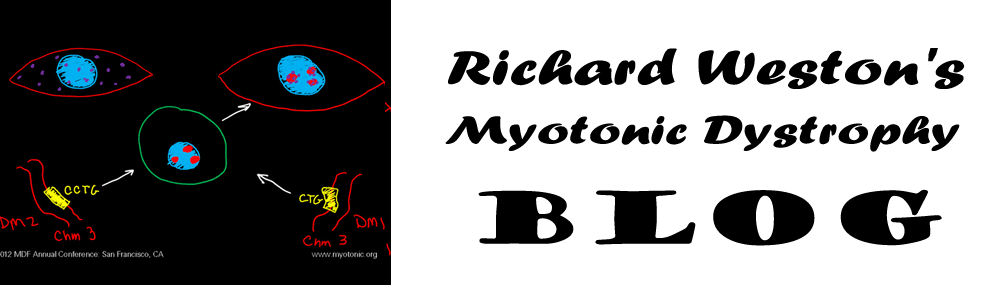
Researchers have previously identified what they think is the cause of the disease.In Myotonic Dystrophy the repeat expansion mutation is made into RNA but it does not get out into the cytoplasm. It remains trapped in the nucleus where it sticks to various proteins and appears as spots or foci that can be observed down the microscope. Because these proteins are stuck to the repeat RNA they cannot perform their normal functions correctly within the cell.

Researchers have found that to make progress with this disease, they need to “unstick” the proteins. This drug appears to do this in mice and cells.

Previously to the publication of this article there was no even theoretical treatment available. There are several drugs in development but this takes years of development. For those near end of life with this disease there is now a potential treatment. A copy of the article is here. This is something you may want to discuss with your medical team. Its untried and potentially risky with side effects. More information will be available shortly.

Myotonic Dystrophy Treatment

Please note the study is very technical. We are not recommending this to anyone but bringing all the current information to your attention

How does Myotonic Dystrophy affect the brain and higher level functioning

A recent study gave more information on how Myotonic Dystrophy affects the brain. This information is important as treatments are being developed and there are many questions on whether this will help with brain related issues. The study below gives information on white matter and gray matter in the brain that were obtained with MRI studies. The Gray matter seems to give some indication of how a patient may be affected with The various symptoms of myotonic dystrophy.  Here is a summary of the study. Click Below to get the full study in PDF


Genetics affect the Brain May 2015

Family Day at IDMC-10 Looks Wonderful

There will be a family day free of charge at the IDMC10 conference in Paris this year. Every two years hundreds of researchers gather to discuss the latest and greatest in the field. This year the meeting is June 8-12th in Paris France.At the end of the conference there is generally a patient day where new information about the disease is released to the public in a less scientific way.  Here is an outline of the family Program

IDMC10 meets Families’ Day of AFM-Telethon

June 12, from 15:00.

Continue reading

Draft report from the Muscular Dystrophy Coordinating Committee

The Muscular Dystrophy Coordinating Committee (MDCC)
MDCC is a government mandate to try and coordinate the research establish to coordinate activities to find cure, treatment and handling daily living of People with Muscular dystrophy : The Muscular Dystrophy Community Assistance, Research, and Education Amendments of 2001 (MD-CARE Act; P.L. 107-84) authorized the establishment of the MDCC, with members appointed by the Secretary of the Department of Health and Human Services, in order to coordinate activities across the National Institutes of Health (NIH) and with other Federal health programs and activities relevant to the various forms of muscular dystrophy. The MDCC was subsequently re-authorized in the MD-CARE Acts of 2008 and 2014, with changes in its composition with each re-authorization.

Click Below for full copy of the Plan

MDCC Action Plan 2015 draft

Florida Funding attract Key Myotonic Dystrophy Researchers to University of Florida

Building a Preeminent Research Program: The Center for NeuroGenetics

As an introduction to this newsletter, please check out a video created by Eric Wang, Ph.D., who is joining UF as an assistant professor of molecular genetics and microbiology in the Center for NeuroGenetics. This edition of On The Same Page is the story of how new and existing faculty can come together to create preeminent research programs.

In the UF community, the concept of “preeminence” has been used quite a bit of late. Florida’s “Preeminence Bill,” signed into law during the 2013 legislative session, designated the University of Florida as a preeminent university in the state. To help UF attain its goal of becoming a top 10 public university, a section of this bill provides funds to UF for the purpose of attracting outstanding faculty to advance our research mission.

Continue reading