General Information

Myotonic Dystrophy is a disease that is genetically based and inherited from one generation to the next. One out of two of a person with myotonic dystrophy will most likely have symptoms of the disease. Unlike most diseases, the symptoms that a person with this disease varies from person to person. Some people are just mildly affected others are severely affected. This makes it hard to tell you exactly how the disease will affect a particular individual.

Myotonic dystrophy is a rare disease with an incidence of about one in 8000. The incidence of the congenital form is higher with an incidence of 1/100,000 That means that most doctors will not have a patient with the disease in their practice. Thus, many people are turning to organizations like the International Myotonic Dystrophy Organization (IMDO) for help and assistance.

Myotonic Dystrophy is generally classified into two types. One is extremely rare and we will not deal with that type in our pages. The other type can be subdivided into 4 distinct Types:

Congenital: Appears at birth and is most severe (not likely with DM2)
Juvenile: Appears after birth and in teen years
Adult: Appears in the late 20′s to early 40′s
Late Onset: Appears later after 40′s and generally mild

As a general rule the earlier the disease is apparent or can be detected the more severe the symptoms will be.

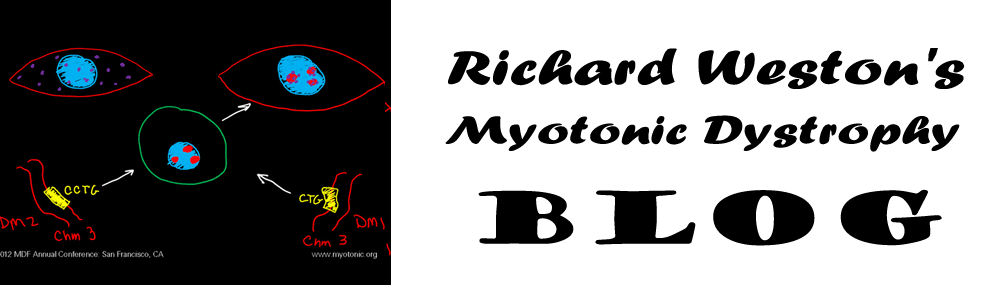
Myotonic Dystrophy is caused by an excessive number of CTG repeats on Chromosome 19. A “normal” number of Repeats is 5-38, Over 38 and myotonic dystrophy can occur. In the most severe congenital form the number of repeats is over 3,000. The disease has an effect called “anticipation” This means that the disease gets progressively worse with each generation. As a general rule 50% of the children will inherent the disease. It is particularly important that female members of the family in childbearing years be tested with a DNA test to find out if they have the disease. This can prevent the most severe from of the disease, the congenital form, from occurring. A new form of myotonic Dystrophy was discovered in August of 2001.

There are now two types of myotonic Dystrophy

DM1 is known as Type 1
DM2 is know as Type 2 also known as PROMM or “Proximal Myotonic Myopathia”

DM1 is caused by an expanded repeat of CTG on Chromosome 19
DM2 is caused by an expanded quadruplet repeat of CCTG on Chromosome 3

Differences in DM1 and DM2

DM2 does not seem to cause the severe congenital form when the mother that has the disease has an infant. Also the apathetic personality traits with DM1 do not seem to be associated with DM2. People with DM2 will have more weakness in the trunk of the body (proximal) versus DM1 will have more weakness in the distal parts of the body like legs and arms.

Myotonic Dystrophy is known as a multisystem disease. That means that the various types of tissue and organs are affected. Thus, the disease may affect the eyes, heart, and muscles. This is somewhat different than most diseases. Most disease will affect just one system. This basic mechanism of why different systems are affected is unknown. Recently a hypothesis that it is a small cellular component called Messenger RNA that might be the culprit. However it can be inferred that some type of biochemical mechanism or other mechanism that can have a more universal affect.

The disease causes a lot of unusual problems in people with the disease. They may have trouble staying awake and have low energy levels. They may have depression. There may be hair loss or digestive problems. It is very hard to relay to people that this is a real disease and that the problems are real and not just a result of lack of motivation. In fact, lack of motivation is one of the results of the disease.

You also might be accessing the site to find out if you have the disease. The definitive test for Myotonic Dystrophy is the a Chromosome test but the grip test will usually allow you a quick and easy way to know if an individual may be afflicted with Myotonic Dystrophy. Affected individuals will not be able to open and close their hand rapidly and will have a characteristic grip. View these images below to confirm diagnosis. (It may take about 1 minute to load these at 56K)

Go to Grip Test Image      Go to Grip Test Release

This site concentrates on information on myotonic dystrophy. If you are looking for information on Myotonic Dystrophy, there is an excellent book called Myotonic Dystrophy it is by Peter S. Harper , it is over 300 pages exclusively devoted to in-depth information on Myotonic Dystrophy. The third edition is now available. You can order this book from the publisher. You may be able to obtain this book through an interlibrary loan from the local medical school. It is somewhat technical but a wealth of information on this subject. I would highly recommend this book.

Congenital Myotonic Dystrophy
The discovery of the congenital form CMD is often a surprise to parents. When the baby is born and has problems and then a neurologist or other doctor may inform them that this is a possible cause. If you are accessing this page you may be trying to find more information about CMD. A birth of a CMD infant may bring two surprises to parents. One is that the baby is affected. The other that the mother is affected. Usually this comes as a complete surprise to the entire family. Sometimes the diagnosis occurs as the result of the infant dying or having a stillborn baby. See Parent Grieving Site.

It could be that you are looking for information on the adult or the juvenile form. You may have had symptoms of the disease and were looking for solutions for years. Finally either you or a doctor put it all together.

While there is some medical information available there is very little social/practical information available. This site is designed to bring together those whose lives share CMD and to further publish information about CMD. We hope that as you read this site and if you have valuable information to share you will do so. However, to further complicate sharing information about this disease, those affected generally have an apathetic attitude about life and have mild to severe motivation to help themselves and others. Luckily there are some support organizations now forming throughout the world.

Activities that Children like

Activities That Children Like

So what kind of things do kids with CMD like to do? I am basing this page on my son, Christopher. You may want to consider some of these activities for Children with CMyD.

Computer

Computer games and video and movement in general seems to keep these kids interested. Christopher uses both a MAC and a PC computer. Early on he used an Edmark Touchscreen but later graduated to a mouse after he hit and damaged the touchscreen. He uses most software that has an age equivalent of about 3-8 years old with most of his skills in the 4 year old range. Some software:

  • Putt Putt on Moon, Parade, Zoo, Arcade
  • Fatty Bear Birthday Surprise
  • Just Grandma and Me
  • The Tortoise and the Hare
  • Thinking things 1
  • Bailey Book House
  • Millie’s Math House
  • Sammy’s Science House
  • Dr. Seuss ABC
  • Blues Clues

At school he works on more “Academic” programs……

Videos & TV

Videos and TV are very captivating. The kids seem to fixate on one for a while and then lose interest and later gain it back. They will tend to act out sections of the video. For example, if the kids are running, Chris will try and copy them running. They will also ask adults or others to join in this running.  New videos take a while for the kid to learn and grow to like them. It might be a few days or weeks before they will watch them regularly.  There are movies we have not had a lot of luck with. Chris watches them for a while but then loses interest. I believe he does not follow the story line. He did like Barney’s Great Adventure though.

Books & Tapes

We were very surprised that one of Chris’s favorite activities was reading books. At school they used a set of books called Rigby Books that were very basic and had an audio portion that matched the books. He loves these. In fact, we never go anywhere now without his tape recorder and tape sets. We are not sure if he follows all the stories. I would highly recommend these tapes.

Rigby Books PO 797 Crystal Lake, IL 60039

(815) 477-3880

www.rigby.com

Moving things

Chris just loves anything that moves. His favorite is driving in the car. He loves car washes, and he really loves to ride the bus. His favorite ride at Disneyland was the Tram that took us from the parking lot to the Park. He also loves trains. They have a train museum with working trains (even steam) near us in IL. He loves to ride on the train.  He loves MD camp as they have a golf cart and he loves to ride on this.

Climbing

Climbing (if abilities allow) is something that CMD kids like to do. Chris climbs on just about everything! He loves the new play area that cities are building now with lots of stuff to climb on. The indoor play places at the fast food places are also fun for him.

Swimming

This is a really exciting activity. Chris loves to be in the water. We often get a very secure life vest and this allows him to paddle around. He really likes water parks as well. You might want to investigate hydrotherapy at your local OT or PT clinic.

Amusement Parks

These parks are full of things that make noise and move. So Chris loves these. Last year he went on a big roller coaster for the first time and he loved it! He has been to Disney and the Orlando Parks. He still likes the Tram ride from the parking lot best of all.

Acting out and Singing

While watching videos or television, kids will tend to want to act out and emulate what is on the screen. If for example the characters fall down, they will want to fall down, etc. They also like for others to participate in this. If verbal, the kids will sing along as well. Christopher is non-verbal but will try to make some sounds or whistles to accompany these areas.

Horseback riding

They have a special location where Chris can go horseback riding for about 1 hour per week. He loves to go horseback riding. He does not like to put the required helmet on though. Most areas have special locations where they help handicapped kids.

What activities are more difficult?

Hair Cuts

Chris hates to have his hair cut and this is a major ordeal for us. We have even tried to cut it ourselves but the results were less than desirable..

Dentist and Doctor

Chris does not like to go to these places and makes this well known. He gets upset just when we drive up to the location.

Computer Failure

This is a major problem when his favorite software will not run….

Children and behaviorial Problems

Behavioral Problems

Both the Roig Study and some personal correspondence have indicated that older children with CMyD have some behavioral issues that might evolve. I only have very scant information on this subject but here are a few behaviors that have been seen:

Oral Fixation: Children or young adults become quite oral and will suck on hands or clothing.

Spontaneous Laughter: Will laugh to some internal thought for no external reason.

Obsessive Bonding: Will follow people around like “glue” and be overly fixated on one person.  This has occurred with parents as well as with grandparents.

ADHD   It’s sometimes very frustrating as if a parent is on the phone or talking with a friend the child will constantly interrupt them. This may be a symptom of Attention Deficit  Hyperactivity  Disorder. Some doctors have placed patients on Ritalin to cope with these symptoms. However, the disorder is more attention deficit rather than hyperactivity.

No Fear of Strangers: Little or no fear of strangers and will follow them around. Some parents report that kids will find strangers that look like relatives, call them by that name and then hold their hand and walk with them.

Conversational Problems: Will ask a question they already know the answer to in an attempt to be included in a conversation. Also lack of skills in structuring a conversation. Also kids will want attention and will interrupt parents to get attention. See ADHD above.

High Voice: Will talk in a voice that is 20 octaves above their normal voice.

Bodily Function Attention: Will do things like pass gas to gain peers attention.

Depression: There have been reports of depression in kids. This can be due to the teasing and alienation that some kids experience while at school. Kids with myotonic dystrophy are different and have a variety of problems. Peer sense these issues and “tease” the kids which can cause behavioral problems.

Repeat Parent Conversation: Will repeat conversations that a parent had.

Recite Movie Dialogue: Will look at person and then recite movie dialogue.

Speak in 3rd Person: May speak about themselves in the third person.

This is just based on a small number of parents’ input. If you have more information about behavioral problems please email me.